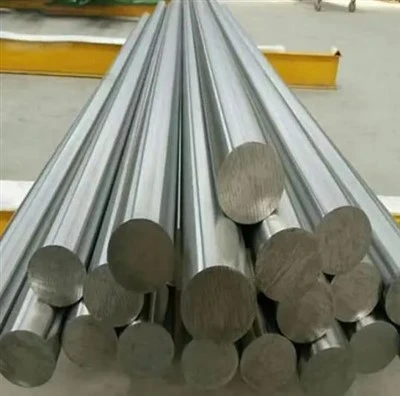
Hey there! As a supplier of spring steel bars, I've been dealing with these nifty pieces of metal for quite a while. One question that often pops up is, "What are the springback characteristics of spring steel bar?" Well, let's dive right into it.


First off, what's springback? Springback is the tendency of a material to return to its original shape after being bent or formed. In the case of spring steel bars, this is a crucial characteristic because it directly affects how well the bars can be used in various applications. You see, when you're making springs or other components out of these bars, you want them to hold their shape as much as possible, but at the same time, a certain amount of springback is inevitable.
Let's talk about the factors that influence the springback characteristics of spring steel bars. One of the most important factors is the material composition. Different types of spring steel bars have different chemical compositions, which can greatly affect their mechanical properties and, in turn, their springback behavior.
For example, the 1095 Spring Steel Bar is a high - carbon steel. High - carbon steels are known for their high strength and hardness. This means that they can withstand a lot of stress without deforming permanently. However, they also tend to have a relatively high springback. When you bend a 1095 spring steel bar, it will try to bounce back to its original shape more vigorously compared to some other types of steel. This can be both an advantage and a disadvantage. On one hand, it allows the bar to maintain its elasticity, which is great for applications where you need a spring to keep its shape over a long period of time. On the other hand, it can make the forming process more challenging because you have to account for the springback when you're bending the bar to the desired shape.
Another popular type is the 5160 Alloy Spring Steel Bar. This is an alloy steel that contains chromium and vanadium. These alloying elements enhance the hardenability and toughness of the steel. The 5160 alloy spring steel bar has a more balanced springback characteristic compared to the 1095. It has enough springback to provide good elasticity, but it's not as extreme as the high - carbon 1095 steel. This makes it a great choice for a wide range of applications, from automotive suspension springs to industrial machinery components.
Then there's the 55SiMnVB Spring Steel Bar. This steel contains silicon, manganese, vanadium, and boron. The addition of these elements improves the strength, toughness, and fatigue resistance of the steel. The springback behavior of the 55SiMnVB spring steel bar is also unique. It has a relatively low springback in some cases, which can be beneficial when you need precise forming. This makes it suitable for applications where tight tolerances are required, such as in precision instruments or aerospace components.
The heat treatment process also plays a significant role in the springback characteristics of spring steel bars. Heat treatment can change the microstructure of the steel, which in turn affects its mechanical properties. For example, quenching and tempering can increase the hardness and strength of the steel, but it can also increase the springback. On the other hand, normalizing can reduce the internal stresses in the steel and result in a more predictable springback behavior.
The amount of deformation also matters. When you bend a spring steel bar to a small angle, the springback is usually relatively small. But as you increase the bending angle, the springback becomes more significant. This is because the internal stresses in the steel increase with the amount of deformation. So, if you're making a complex shape with multiple bends, you have to be extra careful about accounting for the springback at each bend.
The surface condition of the spring steel bar can also influence springback. A smooth surface can reduce friction during the bending process, which can affect the distribution of internal stresses and, consequently, the springback. Rust or other surface defects can cause uneven stress distribution, leading to unpredictable springback.
Now, why is understanding these springback characteristics so important for you as a customer? Well, if you're in the business of making springs or other components out of spring steel bars, knowing how much springback to expect can save you a lot of time and money. You can design your manufacturing process more efficiently, reducing the number of trial - and - error attempts.
For example, if you're using a 1095 spring steel bar to make a high - performance spring, you'll know that you need to over - bend the bar a bit to account for the high springback. On the other hand, if you're using a 55SiMnVB spring steel bar for a precision application, you can rely on its relatively low and predictable springback to achieve the tight tolerances you need.
As a spring steel bar supplier, I've seen firsthand how different springback characteristics can impact the manufacturing process. That's why we offer a wide range of spring steel bars, each with its own unique set of properties. Whether you need a high - carbon steel for maximum strength or an alloy steel for a more balanced performance, we've got you covered.
If you're interested in learning more about our spring steel bars or have any questions about their springback characteristics, don't hesitate to reach out. We're here to help you find the perfect spring steel bar for your specific application. Our team of experts can provide you with detailed technical information and guidance to ensure that you get the best results.
In conclusion, the springback characteristics of spring steel bars are influenced by a variety of factors, including material composition, heat treatment, amount of deformation, and surface condition. Understanding these characteristics is crucial for efficient manufacturing and high - quality end products. So, if you're in the market for spring steel bars, give us a shout, and let's work together to find the ideal solution for your needs.
References
- "Metallurgy of Steel" by George E. Totten
- "Mechanical Properties of Materials" by James F. Shackelford