Carbon steel wire's torsional strength comes down to two things: carbon content and how the wire is made. More carbon means stronger but more brittle; drawing makes it stronger and less ductile, annealing makes it softer and lowers torsional strength. Here's how the common grades stack up.
Torsional strength by grade
Q195 (low carbon, 0.08–0.12%C)
About 150–200 MPa. Very soft and ductile-it can bend and twist a lot without breaking. Good for wire mesh and anything that gets folded and twisted repeatedly, but not strong enough for high-twist parts like heavy-duty springs.
1010 (low carbon, 0.08–0.13%C, AISI standard)
About 180–220 MPa. Feels almost identical to Q195, very ductile, won't crack during cold heading. Common in bolts and small automotive parts-picked when you need repeated forming rather than high torsional load.
Q275 (medium carbon, 0.25–0.29%C)
About 350–400 MPa. Noticeably stiffer than Q195. Good for fence ties and medium-duty springs. Popular with farmers and construction crews because it holds up when you pull fence tight and doesn't snap after a few bends.
1020 (medium carbon, 0.18–0.23%C)
About 380–430 MPa. A big step up from 1010. Used for clutch springs, appliance wire forms, nail making. I've had customers whose parts kept breaking under repeated twisting on 1010-switching to 1020 fixed it. If your part sees consistent twist, 1020 is usually a safe bet.
45# (high carbon, 0.42–0.50%C)
About 600–650 MPa, the strongest of the bunch. But high-carbon steel is brittle-twist it too far and it snaps instead of bending. Used for heavy machinery springs, wire ropes, parts needing maximum strength. If your part sees sudden twists, don't use 45#; it's for steady, consistent torsion.
Common mistakes
Higher strength isn't automatically better. Match it to the job: a paper clip needs to twist many times without breaking, so 1010/Q195. A car suspension spring needs to twist thousands of times without failing, so 1020/Q275. 45# is too brittle and would snap after a few hundred twists.
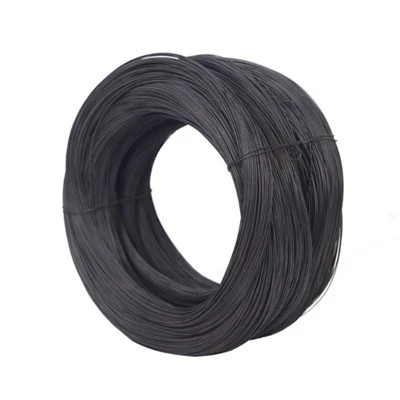
The drawing process can tune the number. Drawing through dies work-hardens the wire-stronger, less ductile. Annealing softens it and lowers torsional strength. A supplier can adjust carbon content and drawing schedule to get close to what you need-say you want around 500 MPa, that's achievable.
Real case. A customer made heavy-duty fence staples and used high-carbon wire because he thought "stronger is better." It snapped when he twisted it to drive it-too brittle. We switched him to Q275, a medium-carbon wire with lower torsional strength but more ductility, and the problem was gone. You want the right match, not just the highest number.
How to choose
Repeated bending/forming: Q195 / 1010
Fencing, medium-duty springs: Q275
Springs and wire forms under continuous twist: 1020
Maximum strength, steady torsion: 45#


References:
- ASTM A510/A510M-18, Standard Specification for General Requirements for Wire Rods and Coarse Round Wire, Carbon Steel
- ASM International. (2019). Torsion Testing of Metals. In ASM Handbook, Volume 8: Mechanical Testing and Evaluation.
- The World Steel Association. (2022). Carbon Steel Grades and Properties.
- Metal Powder Industries Federation. (2021). Ductility and Torsional Strength of Carbon Steel Wire.