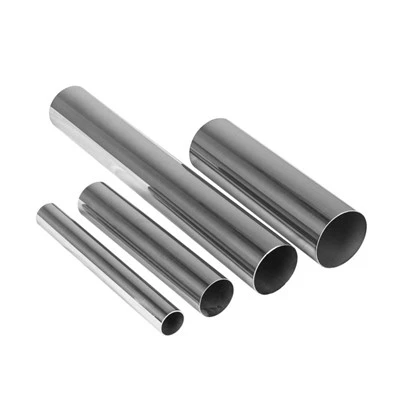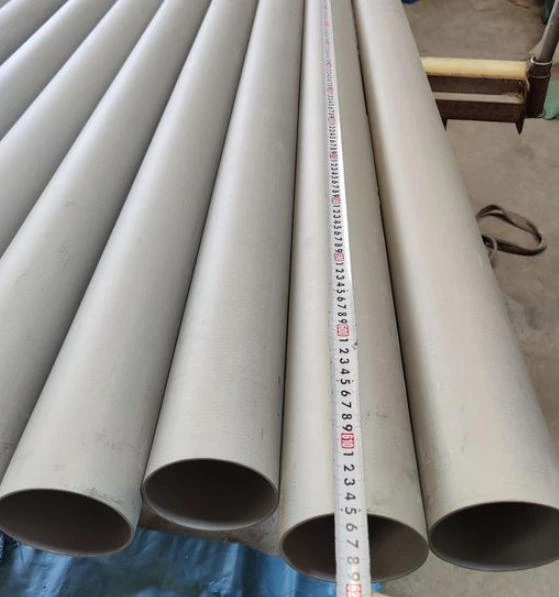


316Ti Stainless Steel Pipe & Tube

316Ti Stainless Steel Pipe for Corrosion and Elevated-Temperature Applications
316Ti Stainless Steel Pipe is a titanium-stabilized austenitic stainless steel pipe with good corrosion resistance, elevated-temperature stability, and fabrication performance. It is commonly identified as UNS S31635 / EN 1.4571.
The main difference between 316Ti and standard 316 stainless steel is the addition of titanium. Titanium stabilizes the carbon in the steel and helps reduce the risk of sensitization and intergranular corrosion after exposure to certain elevated-temperature conditions.
With chromium, nickel, and molybdenum as its main alloying elements, 316Ti Stainless Steel Tube offers better corrosion resistance than 304-type stainless steel and is suitable for chemical processing equipment, heat exchangers, industrial piping, and welded components operating at elevated temperatures.
Technical Specifications
| Item | Specifications |
|---|---|
| Product Name | 316Ti Stainless Steel Pipe / Tube |
| EN Material No. | 1.4571 |
| EN Designation | X6CrNiMoTi17-12-2 |
| Material Type | Titanium-Stabilized Austenitic Stainless Steel |
| Product Form | Seamless Pipe / Welded Pipe / Seamless Tube / Welded Tube |
| Manufacturing | Cold Drawn / Cold Rolled / Hot Finished / Welded |
| Outside Diameter | 6–630 mm |
| Wall Thickness | 0.5–50 mm |
| Length | 5.8 m / 6 m / 11.8 m / 12 m / Custom Length |
| Delivery Condition | Solution Annealed |
| Surface | Pickled / Bright Annealed / Polished |
| Pipe Ends | Plain End / Beveled End |
| Element | Composition |
|---|---|
| Carbon (C) | ≤ 0.08% |
| Silicon (Si) | ≤ 1.00% |
| Manganese (Mn) | ≤ 2.00% |
| Phosphorus (P) | ≤ 0.045% |
| Sulfur (S) | ≤ 0.030% |
| Chromium (Cr) | 16.5–18.5% |
| Nickel (Ni) | 10.5–13.5% |
| Molybdenum (Mo) | 2.0–2.5% |
| Titanium (Ti) | Stabilized according to applicable standard |
| Iron (Fe) | Balance |
| Property | Typical Value |
|---|---|
| Tensile Strength | ≥ 515 MPa |
| Yield Strength (0.2%) | ≥ 205 MPa |
| Elongation | ≥ 35–40% |
| Hardness | According to applicable standard |
Key Features of 316Ti Stainless Steel Pipe
Titanium-Stabilized for Thermal Exposure
The titanium addition is the defining feature of 316Ti. It helps stabilize the material during welding and prolonged exposure to elevated temperatures.
This makes 316Ti particularly suitable for components where corrosion resistance must be maintained after thermal processing.
Molybdenum-Enhanced Corrosion Resistance
Like other 316-series stainless steels, 316Ti contains molybdenum, which improves resistance to localized corrosion compared with 304 stainless steel.
It is commonly selected for environments involving:
- Industrial chemicals
- Moisture and humid conditions
- Selected chloride-containing media
- Process fluids
- Marine and coastal environments
Actual material selection should still consider chloride concentration, temperature, and service conditions.
Good Weldability and Fabrication
316Ti can be cut, welded, bent, and fabricated for industrial applications. The material's austenitic structure also provides good toughness and formability.
For fabricated piping systems, the stability of the material after welding is one of the reasons 316Ti is specified.
Suitable for Pipe and Tube Production
316Ti is available in both pipe and tube forms.
Important product characteristics include:
- Stable wall thickness
- Controlled outside diameter
- Good straightness
- Uniform surface quality
- Solution-annealed condition
- Pickled or bright surface finish
These details are particularly important for heat exchangers, fabricated piping, and equipment manufacturing.
Typical Applications
316Ti Stainless Steel Pipe and Tube is commonly used in:
- Chemical processing equipment
- Heat exchangers
- Industrial piping systems
- Petrochemical equipment
- Process equipment
- High-temperature components
- Marine and coastal installations
- Pharmaceutical equipment
- Food processing equipment
- Fabricated stainless steel structures

Surface and Delivery Condition
Surface condition can directly affect subsequent fabrication and corrosion performance.
Common options include:
-
Pickled Surface
Removes heat tint and surface scale after heat treatment and provides a clean industrial finish.
-
Bright Annealed Surface
Provides a smoother and brighter surface, commonly used where surface appearance and cleanliness are important.
-
Polished Surface
Available for equipment and fabrication applications requiring improved surface smoothness.
-
Solution Annealed
A common delivery condition for austenitic stainless steel pipe and tube. Solution annealing restores corrosion resistance and helps achieve the required mechanical properties.
Hot Tags: 316ti stainless steel pipe, China 316ti stainless steel pipe manufacturers, factory, 304 Stainless Steel Pipe, 316L Stainless Steel Tube, 410 stainless pipe, ASTM A312 TP321 Stainless Steel Pipe, SS 316L Pipe, ss 410 seamless tubes